Boring Future / Labs · Applied systems research
Real work in. Reusable capability out.
Labs is the product and research engine inside Boring Future. It turns what repeats across real delivery into reusable agent architecture, integrations, deployment tooling and operating patterns, with human authority designed in rather than added later.
01 · From Labs
What we’re learning, written down.
Essays and field notes from building and running these systems, the shorter notes and research questions behind them, and benchmarks you can run yourself.
Essay · 7 min read
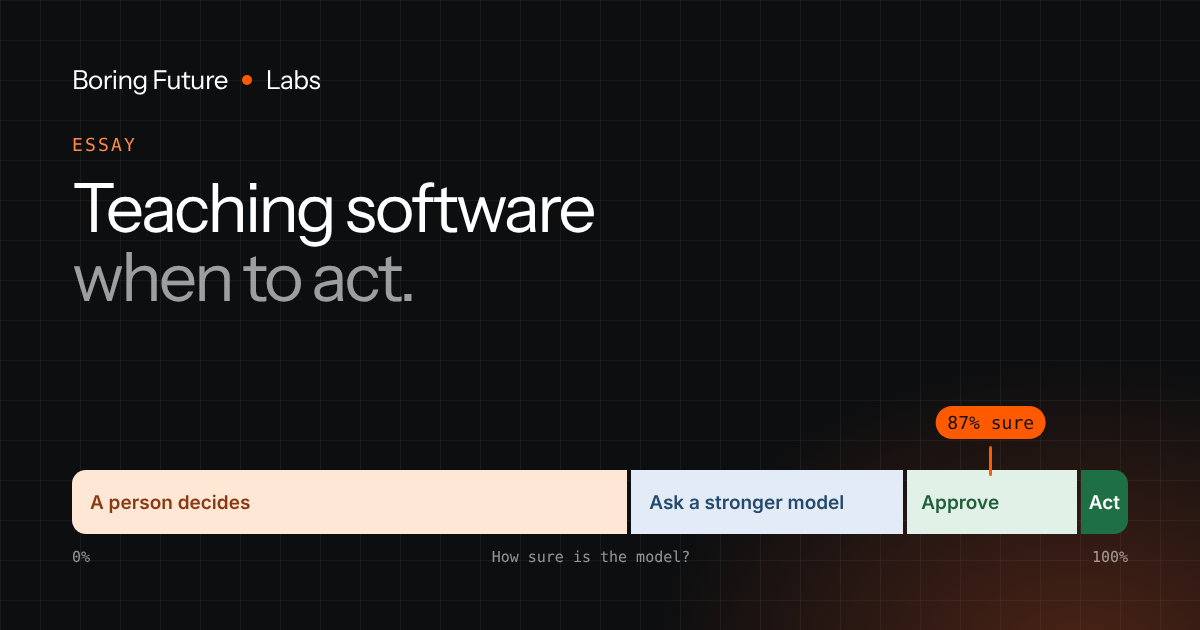
Teaching software when to act.
Most business work doesn’t need AI to write anything. It needs a dependable answer to a small question, and an honest sense of how sure that answer is. Why models like Jev change what automation can safely do.
Field notes · 9 min read
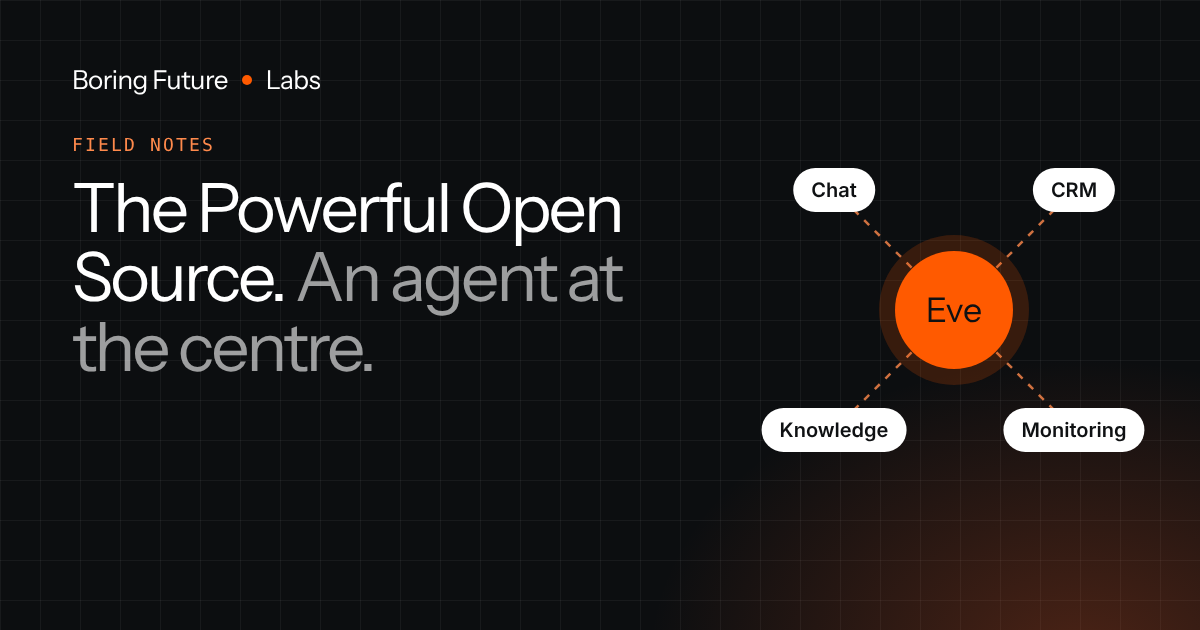
The Powerful Open Source. A whole company’s software, with an agent at the centre.
Open-source business software is now good enough to run most of a small company. Give an AI agent access to all of it and the separate tools start working as one. What we learned building it for about £38 a month.
- Live benchmarksBenchmarks you can run.Decision models that answer with probabilities, and Haiku 5.5 against GPT-6 Luna on the same operational briefs, including a hotel room awaiting inspection.Open
- Live sandboxIs the job done?An engineer's after photo against the work order. Two decision models and a calibrated gate close the job, ask for a clearer photo or send it to a person. Run it on fifty-four synthetic jobs.Open
- Live sandboxDoes the receipt match the claim?A phone photo of a receipt against the expense claim and the policy. Two decision models and a calibrated gate approve it, query the claimant or send it to a manager. A hundred synthetic claims, with a blind set.Open
- The Probability BenchRun it with your own key.Forty-five operational cases against a decision model: accuracy, calibration, confidence gating, determinism and robustness. Bring a TypeSafe key, held only in your browser, or use the labelled simulator.Open
- Lab NotesShort entries from the building.Where an agent should stop, why observability is part of the product, and integration before replacement.Open
- ResearchQuestions in the open.Human authority as architecture, the administrative tax on judgement, and customer service after automation.Open
- Trusted partners · Password protectedSomething else for our trusted partners.A private sandbox we share with the people we build with. Partners have the password. If you’d like to be one, start a conversation.Sign in
02 · A worked example
One request, followed all the way through.
Before the architecture, the reason for it: what the system gathers, what it prepares, where it stops, and what the person responsible receives. Illustrative, not a client record.
- 01 · Input
A request arrives.
- “Order 4821 is late. Can it still arrive by Friday?”
- An email, with no order reference.
- 02 · Context layer
The context it gathers.
- Matched to Harper & Co and order 4821
- Supplier update: held since Tuesday
- Last call: Friday was promised
- 03 · Workflow layer
What it prepares.
- Where the order is, in three lines
- A draft reply from approved wording
- The options: wait, expedite or substitute
- 04 · Authority layer
Where it stops.
- It does not promise a date
- It does not spend money
- Any change to the commitment goes to the account owner
- 05 · The person
What the person receives.
- The brief, the open questions and the options
- The authority to choose, within an agreed limit
- The conversation, which stays theirs
03 · The object graph
What the context layer connects.
The objects a business already runs on and the relationships between them, across three sectors. Choose a sector or an object to see what it links to. Illustrative.
- Objects 18
- Links 23
- Sectors 3
- Authority: human by default
- Illustrative
04 · Architecture
Three layers. One accountable system.
Every Labs pattern is built on the same stack. Context is connected, not copied. Workflows act within limits. Authority sits on top, where people can see it.
- 03
Authority layer
Who may act, who must review and what gets recorded. Permissions, approvals, reversible actions and the audit trail.
- Permissions
- Review points
- Escalation
- Audit trail
- 02
Workflow layer
Rules for what is certain, AI for what needs interpreting, and routes for everything else. Monitored in production.
- Rules
- AI-assisted steps
- Exception routes
- Monitoring
- 01
Context layer
The objects a business already runs on, connected: cases, orders, documents, people and the relationships between them.
- Connectors
- Objects
- Relationships
- Permissioned retrieval
Integration, not replacement. Preparation, not opaque delegation.
05 · Explore a workflow
Three patterns. One way of working.
Trades, professional services and customer experience, including where the system stops and a person takes responsibility. A demonstration, not a deployed product: Roofers Edge is a deployed system, the others an active pattern and a research direction.
Pipeline
- 01Field captureDone
- 02Evidence linkedDone
- 03Hours checkedFlagged
- 04Supervisor reviewRunning
- 05Invoice preparedWaiting
Run log Live
- 09:41:00capturewo=WO-1042 photos=6 timesheet=1OK
- 09:41:07linkevidence -> work_order provenance=keptOK
- 09:41:14checkhours vs schedule delta=+1.5hFLAG
- 09:41:21routesupervisor_review reason=deltaHUMAN
- 09:41:28holdinvoice_draft until approvalWAIT
06 · Capability matrix
Useful intelligence. Accountable systems.
What Labs builds and maintains, and the authority each capability carries. Deployed means in use in delivered work, Active means in development, Research means being explored.
Run the decision-model benchmark| Capability | Description | Type | Authority | Status |
|---|---|---|---|---|
| Agent architecture | Role-based agents within defined responsibilities, permissions and escalation paths. | Architecture | Defined | Active |
| Workflow intelligence | Gather context, identify exceptions and prepare work before it reaches the person responsible. | Workflow | Human | Deployed |
| Integrations | Connectors across communication, knowledge, CRM, operations, finance and project systems. | Connector | Scoped | Deployed |
| Knowledge systems | Private retrieval that keeps sources visible and respects information boundaries. | Knowledge | Permissioned | Active |
| Boundaries | Reusable patterns for permissions, approvals, scopes, reversible actions and escalation. | Control | Explicit | Active |
| Observability | Logs, decisions, evaluations and traces that make intelligent systems inspectable. | Operations | Auditable | Active |
| Deployment | Infrastructure for deploying, securing and maintaining intelligent workflows in real environments. | Infrastructure | Governed | Research |
| Feedback | Measurement that shows whether the technology improves the work, not merely whether it ran. | Evaluation | Measured | Active |
| Decision models | Typed decisions with probabilities, benchmarked in the open against known answers before they route real work. | Evaluation | Measured | Active |
07 · The flywheel
Some problems repeat. We build them once.
Boring Future finds the problem and solves it with the client. Labs productises what repeats. Boring Future deploys it faster next time.
- 01
Discover
Boring Future finds the problem inside real work.
- 02
Design
Automate, augment or keep human, decided with the client.
- 03
Deploy
Connected to the systems already in use.
- 04
Operate
Monitored, reviewed and adapted in production.
- 05
Productise
Labs turns what repeats into reusable capability.
08 · Charter
What Labs will not become.
- NotA generic software bundle
- NotA hosting reseller
- NotA replacement platform
- NotAn AI feature factory
- NotA headcount reduction tool
Bring us the problem that keeps repeating.
A free conversation, thirty to forty-five minutes. If it repeats across businesses, it may already be on its way to becoming a pattern.