Boring Future / Labs · Essay
Teaching software when to act.
Most business work doesn’t need AI to write anything. It needs a dependable answer to a small question, and an honest sense of how sure that answer is. Why models like Jev change what automation can safely do.
Most work isn’t a writing task.
Think about what actually happens when an invoice lands in a finance inbox. Nobody needs a poem about it. Someone needs to answer a handful of small questions. What is this? What should happen next? Is it safe to process automatically? Does a person need to look at it?
Those questions don’t need a paragraph. They need an answer you can rely on. Yet much of today’s AI automation hands each one to a large language model, the kind behind ChatGPT, and asks it to reason the whole thing through and write its answer out. Every time, for every item.
It works, after a fashion. But it’s a little like asking a senior barrister to sort the post: capable, slow, expensive, and not quite the right tool.
A different kind of model.
Jev, built by TypeSafe, is an early example of what we think of as determination models. You give it the situation and the questions you need answered. It gives back an answer to each, in a fixed form, with a probability attached. There’s no free text to interpret.
Asking a language model
“Here’s an invoice. Should we pay it? Reply in exactly this format, and nothing else…”
Looking at this invoice, the supplier appears to be one we have worked with before, and the amount broadly matches the purchase order, although there is a small difference in the delivery charge that may need…
- Read the reply
- Check it followed the format
- Hope it did
Asking a determination model
The situation the invoice, the purchase order, the supplier record
The questions pay it? seen it before? needs approval?
| Pay it? | Yes | 97% |
|---|---|---|
| Seen it before? | No | 99% |
| Needs approval? | No | 88% |
Software uses the answer directly.
That difference sounds technical, but it matters a great deal in practice. With a language model, the software has to ask for an answer in a particular format, read the reply, check it followed the rules, and hope it did. With a determination model, the answer arrives ready to use.
Confidence becomes part of the workflow.
Today, automation tends to be all or nothing. Either you write fixed rules, which break as soon as reality gets messy, or you give an AI agent broad authority and hope for the best.
A confidence score gives you everything in between. The system can say, in effect: “I’m 99% sure, so I’ll just do it.” Or “87%, so I’ll prepare it and ask someone to approve.” Or “61%, so I’ll ask a more capable model.” Or “42%, so this goes to a person, with the evidence already gathered.” Try it:
87%
Prepare it for approval
The work is done up to the last step, and a person approves it with one click.
The model doesn’t need to be perfect. It needs to be right often enough, and honest about when it might not be.
That’s the shift. The surrounding system, not the model, decides how much authority to hand over, and it decides based on evidence rather than hope.
Why this changes the economics.
The most powerful AI models are extraordinary, and expensive to run at volume. Using them for thousands of routine yes-or-no calls is paying for brilliance you don’t need.
Determination models are built for fast, bounded decisions rather than writing text word by word. They can take on the many routine calls (classifying, routing, checking, choosing the next step) quickly and cheaply. The powerful models become the escalation route, not the default. And people’s attention goes where it genuinely earns its keep.
- Determination modelsThe many routine calls: classifying, routing, checking, choosing the next step. Fast and cheap.
- Powerful AI modelsThe genuinely ambiguous cases, where careful reasoning earns its cost.
- PeopleWhere the stakes, the uncertainty or the judgement call it for.
Business runs on small decisions, chained together.
Look closely at almost any operational process and you’ll find the same pattern: a sequence of small judgements, each one simple, all of them necessary. Here’s an invoice, taken one decision at a time.
An invoice arrives Supplier invoice INV-20418 · £4,312.60
- Is the supplier genuine?Yes99%
- Have we seen this invoice before?No98%
- Does the VAT look right?Yes96%
- Does it match the purchase order?Yes93%
- Is the difference acceptable?Not sure46%
Outcome: four checks settle themselves. The one it isn’t sure about goes to the accounts team, with the order, the invoice and the £41.20 difference already side by side.
The same shape turns up everywhere:
A work order changes
- What actually happened?
- Who owns the next step?
- Is the delay down to parts, access, a contractor or something else?
- Should someone step in?
An AI agent reaches a new screen
- Did the last step work?
- Which button comes next?
- Is this unusual enough to hand to a stronger model?
None of these questions needs an essay. Each needs a dependable answer, and an honest sense of how dependable it is. Those are determination problems, and there are a great many of them.
The shape of the systems to come.
Put this together and a clear architecture emerges. Every piece of work passes through six stages:
- Observe
- Constrain
- Determine
- Govern
- Execute
- Verify
And each kind of intelligence does the job it’s best at:
Ordinary software
Facts, sums, permissions and firm business rules. Things that must always be exactly right.
Determination models
Judgement calls where fixed rules become brittle: what is this, and what happens next?
Generative AI
The genuinely difficult reasoning, when a case is new, messy or ambiguous.
People
Wherever uncertainty, consequence or organisational judgement calls for it.
Uncertainty you can program.
So the breakthrough isn’t simply that a model like Jev may be faster or cheaper than a large language model. It’s that it makes uncertainty programmable.
Once software can cheaply say not only “I think the answer is X”, but “here are the possible answers, here’s how sure I am of each, and here’s how strongly the evidence supports them”, automation stops being a leap of faith. It becomes something you can tune, inspect and trust a little more each month.
That fits exactly how we think at Boring Future. AI prepares; people decide, except where there’s enough evidence that a person never needed to touch the work at all. The aim isn’t to get rid of careful thinking, whether it comes from people or from powerful models. It’s to stop wasting it on work that doesn’t deserve it, so the rest quietly disappears into reliable infrastructure.
That’s why we think this kind of model, and the work of teaching software when to act, could matter far more than any single product, Jev included.
Generative AI taught computers to create. Determination models may teach software when to act.
What this means for your team
If your team’s day is full of small decisions, this is for you.
Checking, matching, routing, chasing, deciding who picks something up next: that’s exactly the work this approach suits. Bring one workflow to a free conversation and we’ll show you which decisions could settle themselves, which should be prepared for approval, and which should stay firmly with your people.
More from Labs
Field notes · 9 min read
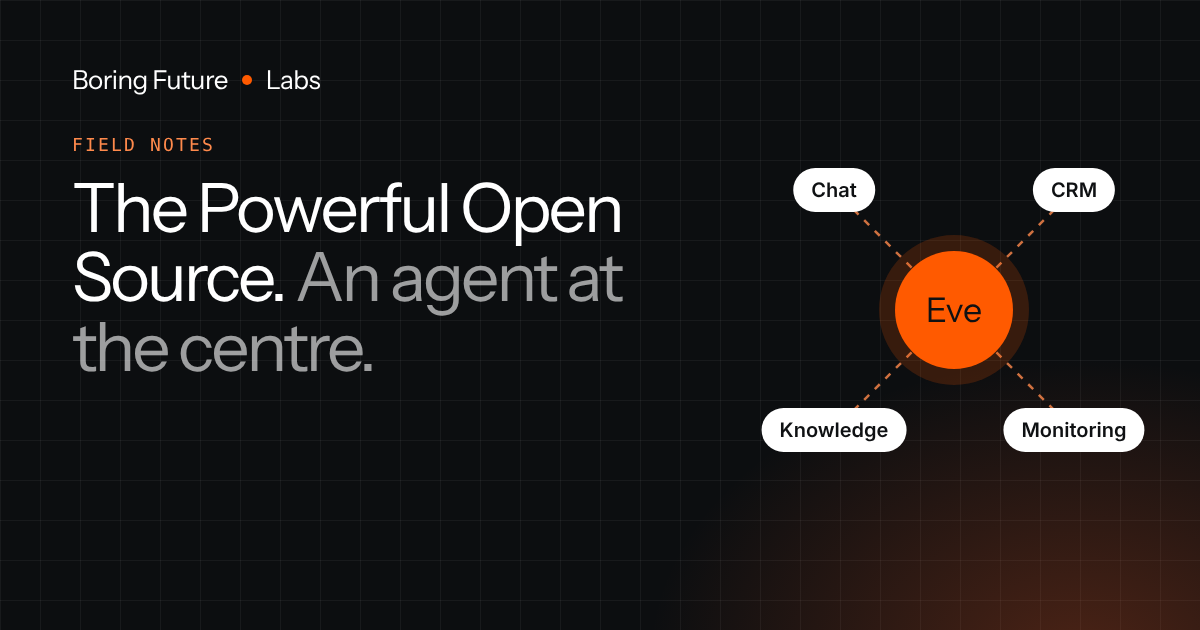
The Powerful Open Source. A whole company’s software, with an agent at the centre.
Open-source business software is now good enough to run most of a small company. Give an AI agent access to all of it and the separate tools start working as one. What we learned building it for about £38 a month.