Boring Future / Labs · Field notes
The Powerful Open Source. A whole company’s software, with an agent at the centre.
Open-source business software is now good enough to run most of a small company. Give an AI agent access to all of it and the separate tools start working as one. What we learned building it for about £38 a month.
This isn’t about a cheaper Teams.
The usual case for open-source business software is saving money: swap Microsoft Teams for Mattermost, or Salesforce for an open-source CRM, and stop paying licence fees. That’s useful. It isn’t transformational.
Here’s the bigger idea. Open-source tools have quietly become good enough to act as building blocks for a complete business operating environment. And once an AI agent can work across all of them, they stop being a collection of separate tools. They become the agent’s workplace.
That’s what we set out to test with the Boring Future Local Ops Centre.
What we built, for about £38 a month.
We started with a single rented server (8 processor cores, 16GB of memory) costing roughly £38 a month. On it, we assembled the core software a small business needs to operate:
- MattermostWhere people, and Eve, talkLike Teams or Slack
- TwentyCustomers, companies and opportunitiesLike Salesforce
- BookStackThe company’s written memoryLike Confluence or a wiki
- Uptime KumaWatches that everything is runningA health monitor
- OpenClaw + our toolingHow Eve reaches all of the aboveThe agent’s hands
None of these applications is revolutionary on its own. That’s rather the point. They’re mature, dependable parts. The interesting thing happened when we stopped thinking of them as five pieces of software and started treating them as one place an agent could work.
We’ve turned capable people into middleware.
Every business system knows its own slice of the truth. The CRM knows one thing, the team chat another, the wiki something else, and the project tool has its own version again. So somebody becomes the glue.
A conversation in Teams gets retyped into Salesforce. Research gets pasted into a document, the document becomes a task, someone updates the CRM, and three weeks later everyone searches their messages trying to piece together what happened.
Today: people as the glue
Someone retypes the conversation into the CRM, turns research into a document, the document into a task, and later searches everything to work out what happened.
With an operating agent
People say what they want in chat. Eve moves the work between systems and brings anything consequential back to a person to approve.
Meet Eve.
So we gave the environment an agent, and called her Eve. Eve sits in Mattermost like any other member of the team. But unlike an ordinary chatbot, her world doesn’t end at the chat window: she can look things up and make changes in the other systems around her.
A chatbot answers a question. An operating agent turns a conversation into changes in the business.
You don’t need to know which system holds what. You say what you’re trying to achieve, Eve works out which tools are needed, and the systems underneath do the work. The whole thing starts to feel less like a software suite and more like a private digital headquarters.
Eve also had a sibling. Eev lived in the same chats and could see the same information, but was deliberately unfiltered: blunt, irreverent and genuinely funny, the colleague who says what everyone else is thinking. The catch was that Eev was read-only. Eev could look at anything and comment on everything, but couldn’t change a thing.
The operator
Careful, precise, shows her receipts
- Reads the company’s systems: yes
- Changes things in them: yes
- Bigger actions wait for a person’s approval: yes
The unfiltered one
Blunt, funny, happy to say what everyone’s thinking
- Reads the company’s systems: yes
- Changes things in them: no
- Free to be candid: it can’t break anything: yes
Eev started as a bit of fun, and it was. But it taught us something serious: personality and permission are separate settings. An agent that can’t act can afford to be playful, candid and fast. An agent that can act has to be careful, precise and accountable. Deciding which is which, deliberately, is part of designing agents people will actually trust and enjoy working with.
One idea, followed all the way through.
Our clearest test was finding new clients. It began as casually as a message in Mattermost: there are probably businesses around Redditch, of a certain size, that could really use automation.
Normally a thought like that disappears into chat history unless someone takes ownership of it. Here’s what happened instead:
- 01 · MattermostConversationA hunch: local firms of a certain size could use automation.
- 02 · BookStackMemoryThe idea and the plan written down, so they don’t vanish into chat.
- 03 · Companies HouseResearchThe official company register, searched by town and postcode.
- 04 · The webEnrichmentWhat each firm actually does, and whether it looks like a fit.
- 05 · TwentyRecordsThe shortlisted companies created in the CRM, sources attached.
- 06 · TwentyOpportunitiesAn opportunity for each, so the pipeline shows the real picture.
- 07 · TwentyTasksThe next action, assigned, with the research beside it.
- 08 · A personOutreachA drafted email, which a person reviews, edits and chooses to send.
Eve wrote the idea and the plan into BookStack, so it became part of the company’s memory rather than a passing comment. She searched Companies House, the UK’s official register of companies, by town and postcode, which gave reliable basics such as each firm’s status, type, age and registered address. Then she researched each firm on the web to judge whether it actually looked like a good fit, and ranked the list.
The shortlisted firms went straight into Twenty as companies, opportunities and tasks, with the research attached. Finally, Eve drafted an introductory email for a person to review. Conversation, memory, official records, web research, analysis and the CRM: six different kinds of work, and nobody had to copy anything from one to the next.
Every action needs a receipt.
Giving an AI access to real business systems exposes a problem that hardly matters in a chat: chatbots can bluff. Operational systems can’t. If Eve says she’s created an opportunity, there had better be an opportunity.
So we wrote down some rules, in plain terms:
- Doing something twice should never create two of anything.
- After every change, check that it really happened.
- Keep the source of every fact.
- Don’t assume two similar names are the same company.
- When something only partly works, say exactly which part.
- Never invent an email address, or anything else.
- Bigger actions need a person’s approval.
Never guess, and never claim it’s done without proof.
Done, and checked✓
- Opportunity created found in the CRM after writing
- Company matched by company number, not by name
- Sources kept the register entry and two web pages
- Ran twice? still one record, not two
Partly done, and saying so!
- Research finished and saved to the wiki
- CRM update failed: the CRM was down at 14:02
- Email address not found, so none invented
- Next will retry the CRM when it’s back
That’s a very different standard from conversational AI. Eve started to behave less like a chatbot and more like a careful colleague using controlled software. (Eev, having no write access, was spared the paperwork.)
A team, not a super-agent.
We also moved away from one giant, all-knowing agent. Instead, specialist agents handle research, sales, operations, knowledge and development (we’ve called them things like Scout, Buzz, Atlas and Scribe), with Eve coordinating them. Each has its own skills, its own tools and, crucially, only the permissions its job needs.
- Research agentCan Search the register and the web; write to the wikiCan’t Touch production infrastructure
- Sales agentCan Create CRM records; draft emails for approvalCan’t Use admin credentials
- Development agentCan Change code in a test environmentCan’t Send anything to a customer
That starts to look a lot like an organisation. And it points to where the real value lies: not in any single agent, but in the system of roles, permissions, workflows, memory, checks and monitoring that connects them.
Own the layer above the apps.
This may be the most important idea of all. The value shouldn’t live inside Twenty, or Mattermost, or BookStack, or any particular AI model. Those will all change. A better CRM will come along. A new model will make today’s look dated.
Yours to keep
Your customers, conversations, knowledge, tasks, rules, permissions and history, in your own shape.
The agents
Eve and the specialist roles: they know what a customer, an opportunity or a message is, whichever app holds it.
Swappable parts
- Chat
- CRM
- Wiki
- Monitoring
- AI models
Swap Twenty for another CRM and Eve still knows what a customer, an opportunity and a task are. Swap the chat app and she still knows what a conversation and a notification are. Swap the AI model and your tools, permissions, knowledge and history all stay put.
Instead of building your company around Salesforce’s or Microsoft’s idea of how it should work, you own the model of your business and plug software into it. That’s what we mean by The Powerful Open Source.
The interface starts to disappear.
There’s a further consequence. Business software has always competed on its screens, because people spend hours in them. But if Eve handles most of the day-to-day work in the CRM, the screens matter much less. What matters is the data underneath, how easily a machine can use it, the permissions and the reliability.
That could be very good news for open source. A modest open-source tool with an excellent way for machines to use it may become more valuable than a beautifully designed product that agents struggle with. The agent becomes the common way in to all of it. Eve becomes the interface.
The cost of software is collapsing.
There was something slightly absurd about the economics. A £38-a-month server held the beginnings of a company’s communications, customer records, knowledge, monitoring, agents and automation.
A serious production version needs more: proper redundancy, backups, security and capacity planning. We’re already planning a larger dedicated production server and our own lab hardware, with production, development, data and AI work kept separate. But the prototype made the point. The expensive part is no longer access to good software. It’s assembling it well.
Why this little experiment mattered.
We began with a server and some open-source applications. We connected Eve to the chat, the wiki, the company register, the web and the CRM. We added monitoring, and thought hard about identity, permissions, checking and failure.
And almost by accident, the collection of applications stopped looking like a technology stack and started looking like a company. People could talk. The organisation could remember. Customers were represented, work was tracked, agents could investigate and act, people approved what mattered, and the system kept an eye on its own health. All on infrastructure the business controls.
None of this means cutting yourself off from the cloud. It still uses leading AI models and outside services where they’re the best choice. It means the centre of gravity belongs to the business: your environment, your memory, your permissions, your choice of models, and parts you can replace without replacing yourself.
For decades, business software has asked people to learn how machines organise work. This points the other way: build the systems underneath, give the agent access, and let people simply say what they’re trying to achieve.
What this means for your team
If your people spend their day carrying information between systems, let’s talk.
The Local Ops Centre is still a Labs project, but the thinking behind it shapes everything we build now: connect what you already have, give the routine work to software that shows its receipts, and keep the decisions with your people. Bring one workflow that eats your team’s time to a free conversation.
More from Labs
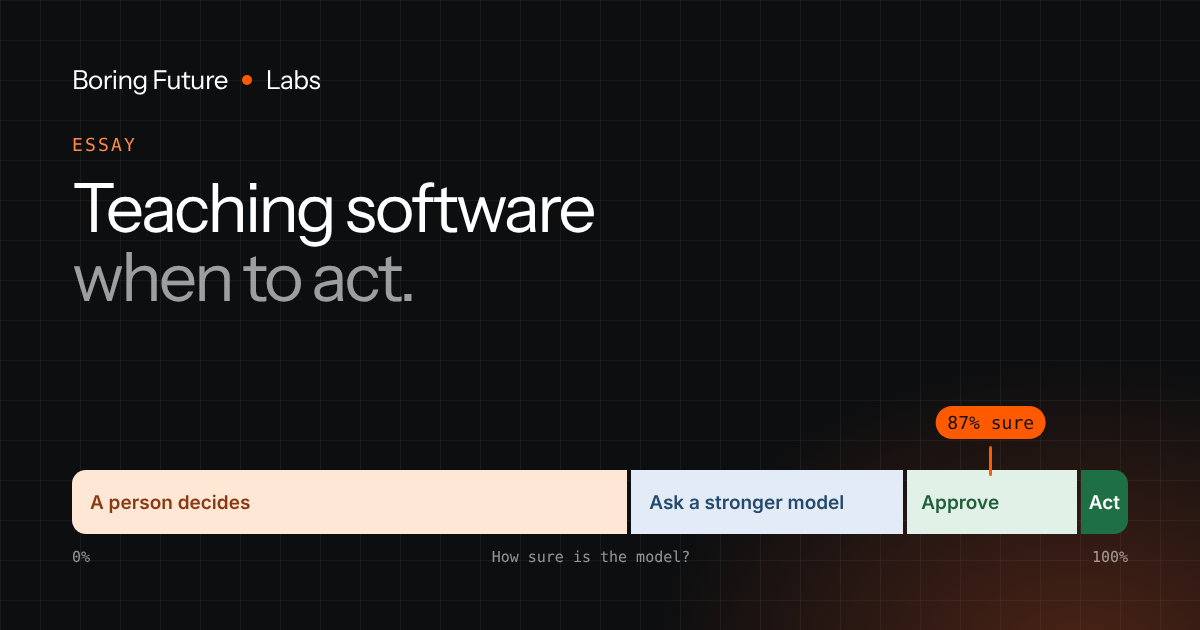
Essay · 7 min read
Teaching software when to act.
Most business work doesn’t need AI to write anything. It needs a dependable answer to a small question, and an honest sense of how sure that answer is. Why models like Jev change what automation can safely do.